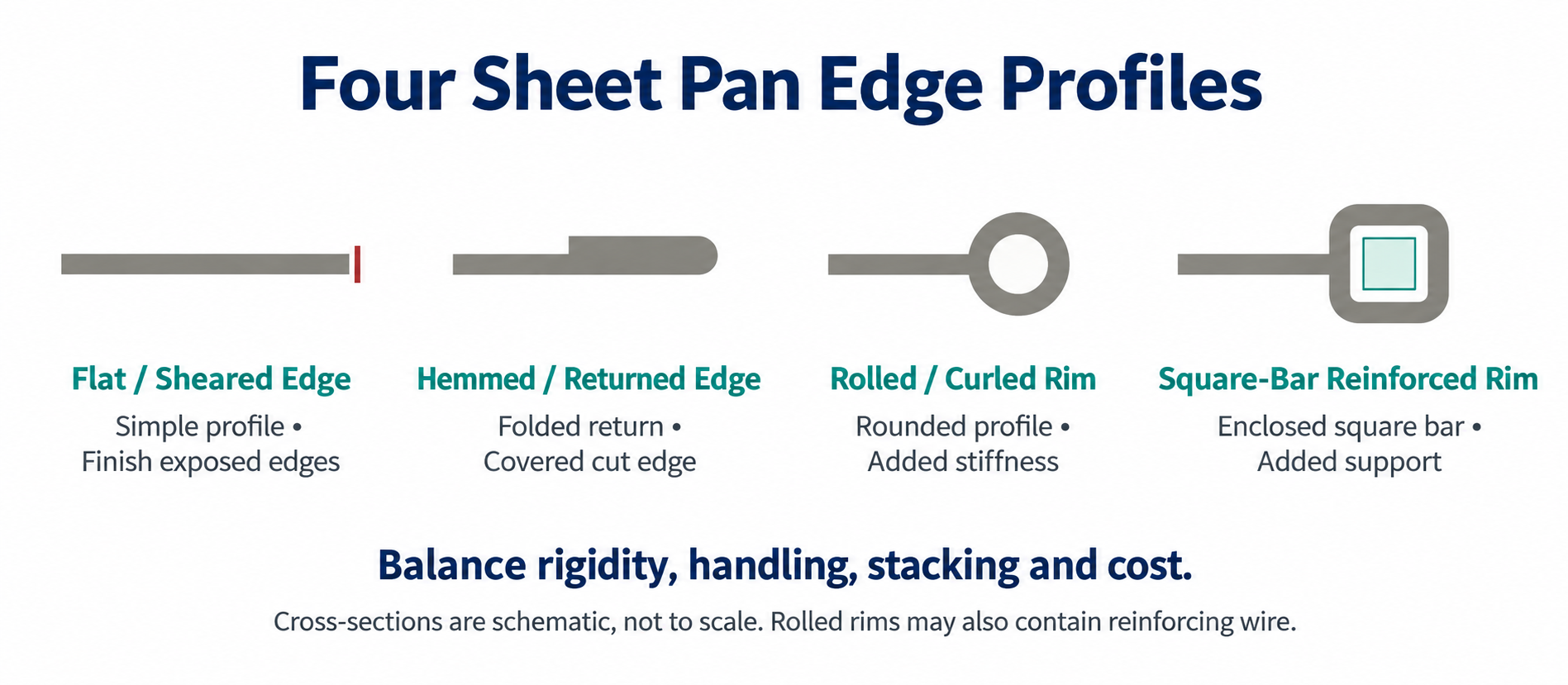
Sheet Pan Edge Types at a Glance
Swipe the table sideways to see all columns.
| Edge construction | Main benefit | Main trade-off | Applications to consider |
|---|---|---|---|
| Flat / sheared edge | Simple construction with a compact edge profile | No folded or inserted rim reinforcement; exposed edges need careful finishing | Lightweight flat trays, supported baking or drying screens, and applications requiring minimal edge projection |
| Hemmed / returned edge | Folds the cut edge back and stiffens the perimeter without a separate reinforcing bar | Folded seams require attention during cleaning; reinforcement is limited compared with a suitably designed framed rim | General bakery trays, compact tray designs and routine handling where cost and edge finish both matter |
| Rolled / curled rim | A rounded handling surface and a stiffer rim profile | Hollow and wire-reinforced versions differ in weight, rigidity and cleaning requirements | Frequently handled sheet pans in bakeries, hotels and commercial kitchens |
| Square-bar reinforced rim | Added perimeter support for demanding handling and tray-system requirements | Additional weight, material and manufacturing work | Large industrial trays, repeated mechanical handling and production lines with defined stacking or conveying requirements |
These are starting points for selection, not a universal strength or price ranking. Compare trays with similar dimensions, material and sheet thickness, then check the complete design.
1. Flat or Sheared Edge: A Simple, Low-Profile Option
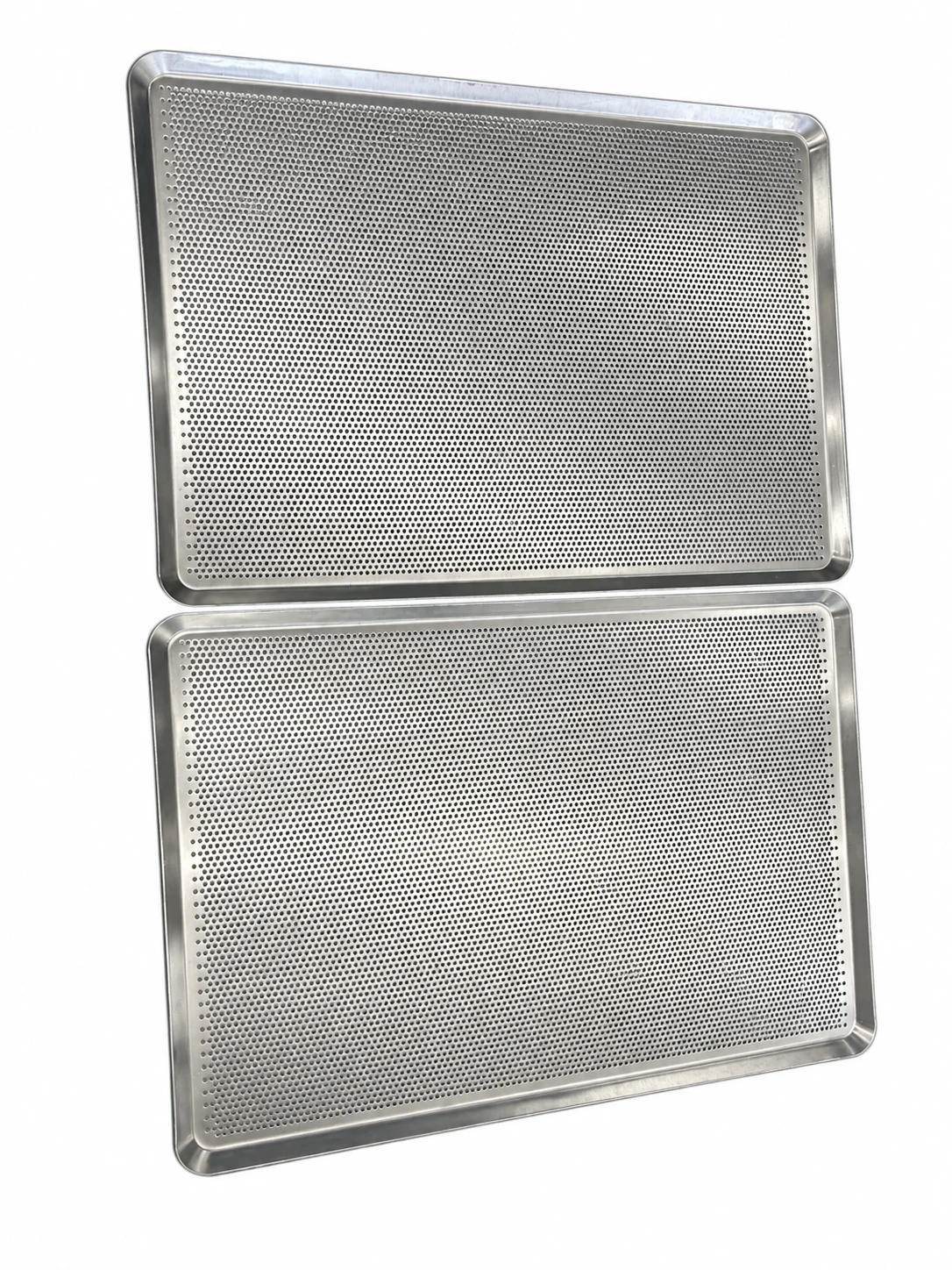
A flat or sheared edge has no hem, curl or enclosed reinforcing bar. The cut edge should be deburred and finished for its intended handling conditions.
This construction can reduce edge-forming work and keep the perimeter compact. It can be useful for flat baking trays or screens that receive support from a rack, carrier or conveyor. It may also suit lightweight products where a substantial reinforced rim is unnecessary.
The limitation is the absence of added rim reinforcement. A large, thin tray may flex during lifting or handling, particularly when loaded. The suitability of this design therefore depends on the sheet thickness, unsupported span, load and operating temperature.
Choose it when: a compact edge and simple construction are priorities, and the tray receives adequate support in use.
Check before ordering: edge finish, loaded deflection and compatibility with handling equipment. An unreinforced edge does not automatically mean a disposable tray, nor does it guarantee faster or more even baking.
2. Hemmed or Returned Edge: A Balance of Finish and Cost
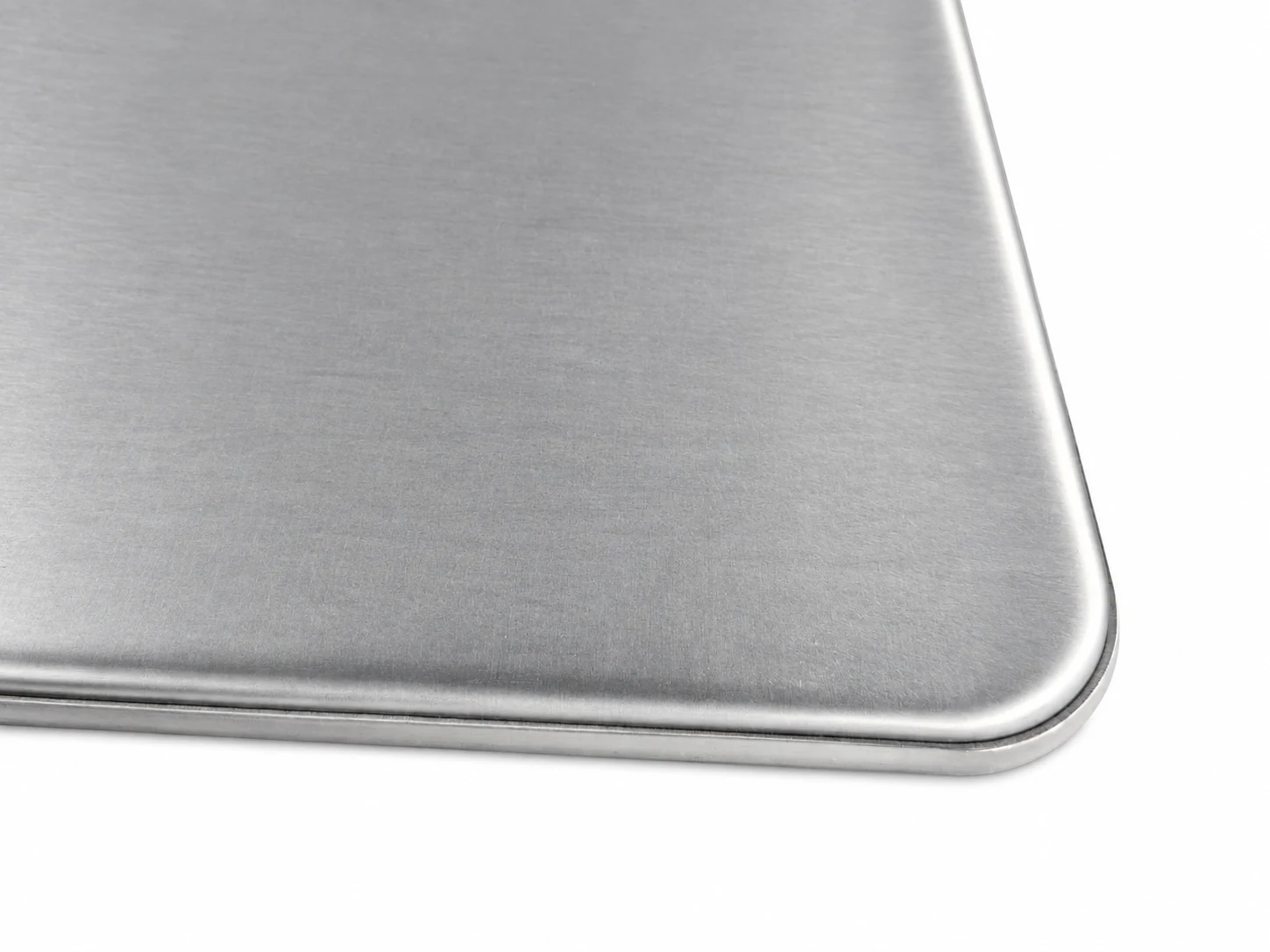
A hemmed edge folds the sheet back onto itself, often through approximately 180 degrees. It covers the cut edge and adds a double layer of material around the perimeter without inserting a separate bar.
For otherwise comparable trays, this can improve edge stiffness over a simple sheared edge. A properly formed hem also reduces exposure to the cut edge during routine handling.
Hemmed edges are worth considering for general bakery trays and designs where a compact perimeter is useful. However, the fold direction and profile matter: an inward fold can affect clearance differently from an outward fold. Always compare the usable baking area as well as the external dimensions.
Choose it when: you want a finished edge and moderate reinforcement while controlling weight and manufacturing complexity.
Check before ordering: the fold quality, corner finish, seam access and available baking area. Small gaps can retain residue or moisture; the actual seam design determines cleaning requirements.
3. Rolled or Curled Rim: A Practical Choice for Frequent Handling
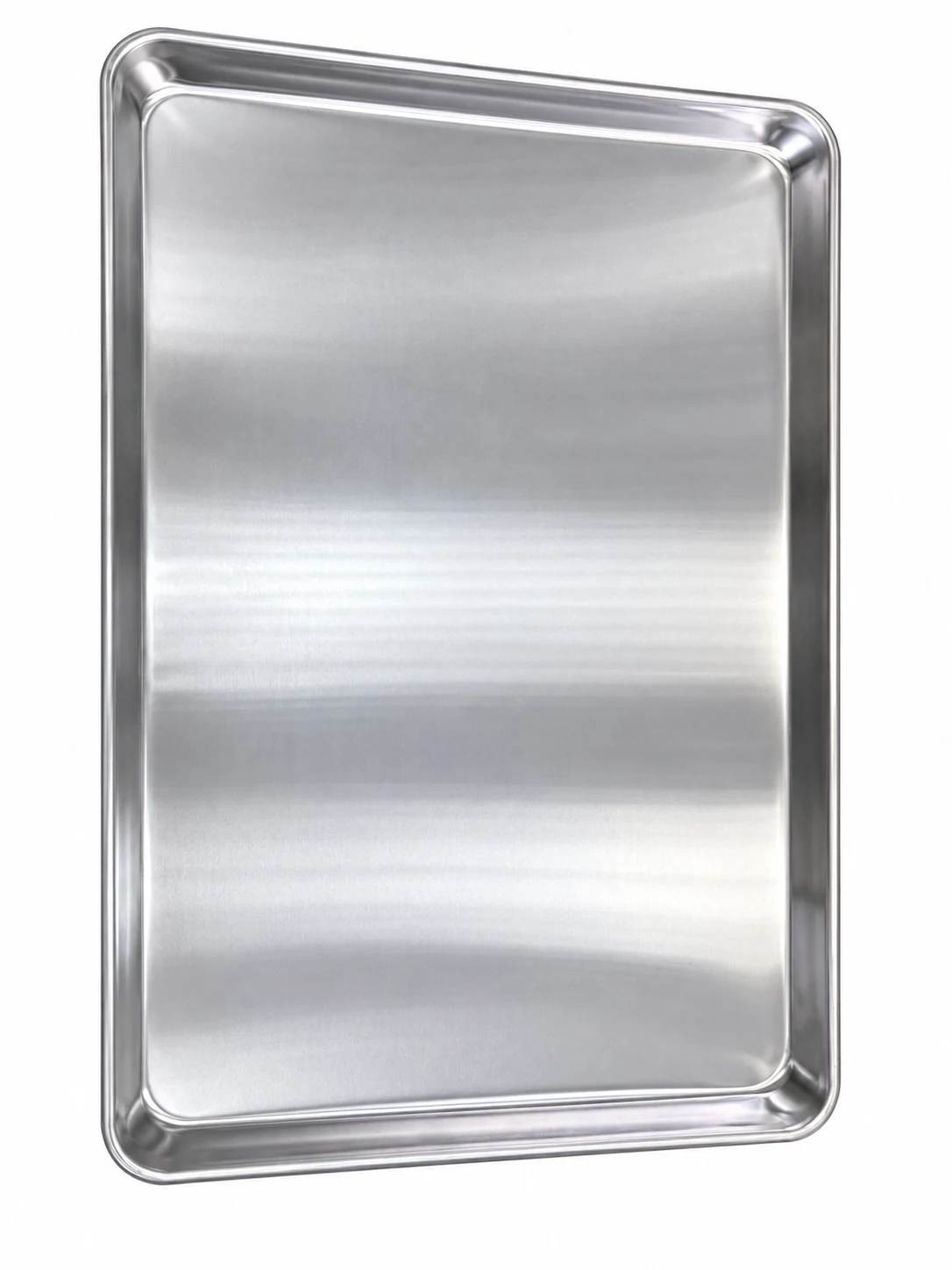
A rolled rim curves the edge into a rounded profile. It may be hollow or formed around a reinforcing wire, so “rolled rim” alone is not a complete specification. For example, Winco describes commercial aluminum sheet pans with galvanized wire reinforcement inside a closed bead. Winco product specification
For bakeries, hotels and commercial kitchens where staff repeatedly load, unload and move trays, a properly finished rounded rim offers a useful handling surface. Its formed profile adds stiffness, with the final result depending on the curl geometry, material thickness and any reinforcement.
Cleaning should be assessed separately. Chicago Metallic offers a semi-curled, sanitary open-bead design that allows access underneath the rim for washing and drying. This illustrates why an open rim should not automatically be described as harder to clean than a closed one. Chicago Metallic rim guidance
Choose it when: frequent manual handling and a rounded perimeter are important.
Check before ordering: whether the rim is hollow or wire-reinforced, the reinforcement material, seam accessibility and drying requirements. A rounded rim alone does not guarantee stable stacking.
4. Square-Bar Reinforced Rim: Added Support for Industrial Trays
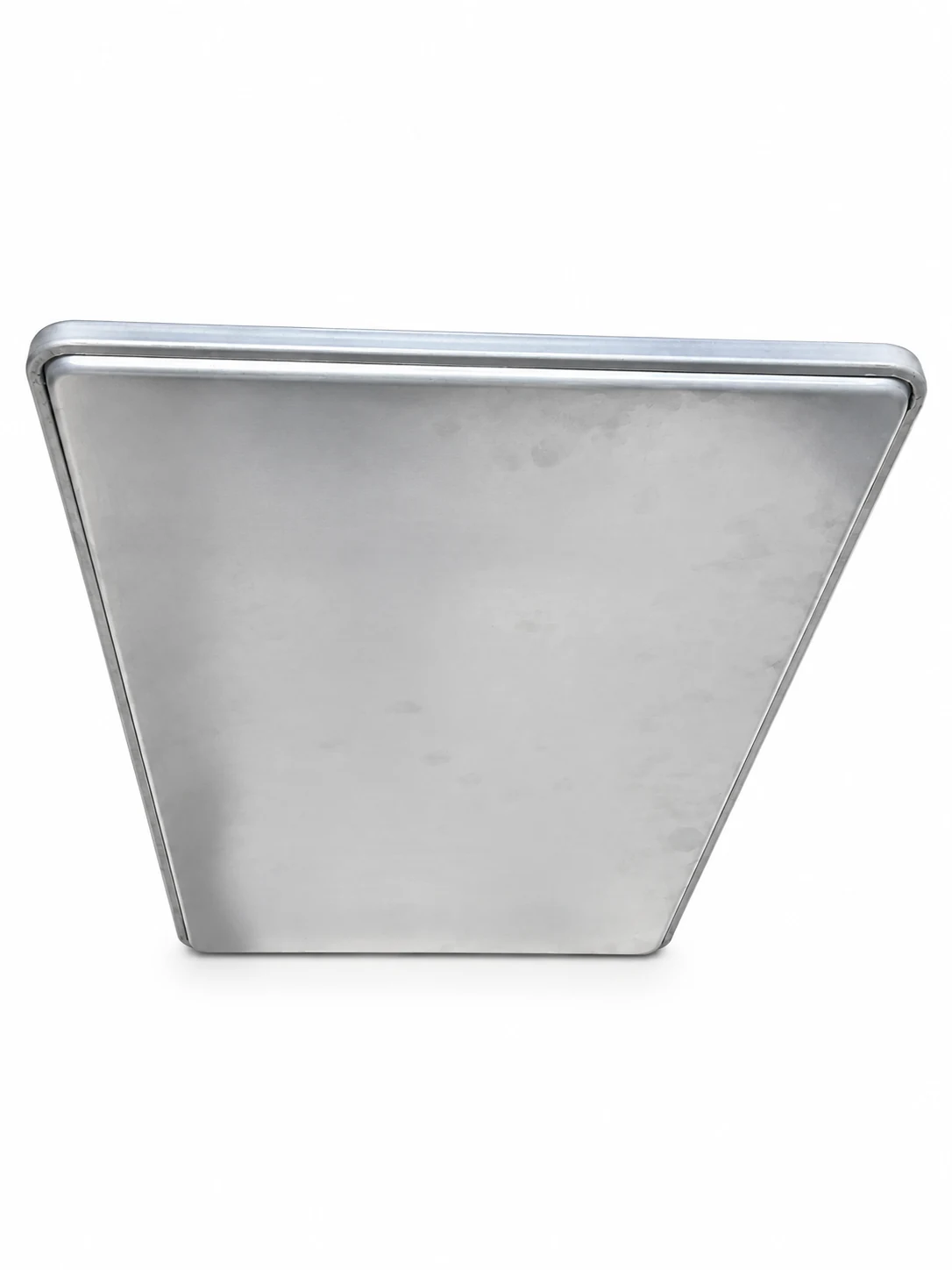
In this construction, the tray edge encloses a square-section metal bar. The bar adds perimeter support, making this an option to assess for large trays and demanding handling cycles.
It is particularly relevant when a factory needs a defined edge profile for stacking, conveyor transfer or mechanical handling. Those functions must be designed into the complete tray: a square bar by itself does not create an interlocking stack or ensure compatibility with an automated line.
Industrial tray manufacturers also offer other reinforced constructions, including wire-in-rim and band-in-rim designs. These terms should not be treated as interchangeable with a solid square bar; request a cross-section drawing. American Pan industrial tray construction options
Choose it when: perimeter rigidity and equipment compatibility justify additional weight and manufacturing work.
Check before ordering: bar dimensions and material, corner joints, finished tray weight, cleaning access and stacking geometry. Confirm performance under the actual oven cycle and load; reinforcement does not make a tray immune to distortion.
Match the Edge to Your Production Process
Use your operation to narrow the options:
- Frequent manual loading and unloading: start by comparing properly finished rolled rims.
- Large trays or repeated mechanical handling: assess a square-bar reinforced rim against the line's support, transfer and stacking requirements.
- Minimal edge projection and supported light loads: consider a deburred flat edge.
- Routine bakery use with a compact perimeter: consider a hemmed edge as a balance of finish, stiffness and manufacturing complexity.
- Frequent washing: inspect the seam and drainage design for every option. Choose a construction that your cleaning process can reach and dry effectively.
Edge construction is only one part of the specification. Material, thickness, pan dimensions, perforation pattern, support conditions and heating cycles all influence the result. Coating selection is a separate decision; see our guide to baking pan coatings.
What to Specify When Ordering Custom Sheet Pans
When comparing commercial baking pans or industrial bakeware, a clear specification makes different pans and trays easier to evaluate. For a useful comparison or quotation, provide:
- Overall length, width and height, plus the required usable baking area.
- Material and sheet thickness.
- Solid or perforated construction, including hole size and layout where applicable.
- An edge cross-section or a clear close-up photograph.
- Reinforcing wire or bar material and dimensions, if required.
- Product load, baking temperature and cycle duration.
- Rack, oven or conveyor dimensions and handling method.
- Stacking or nesting requirements, cleaning method and coating preference.
For a new design, assess a sample with your actual loading, baking, cleaning and stacking process before confirming a production order.
As a custom baking pan manufacturer, we review the edge profile together with the working dimensions, thickness and finish. This helps buyers compare industrial baking pans and oven trays as complete designs rather than choosing by rim name alone.
Explore our commercial sheet pans or prepare your requirements for custom baking pans and trays.